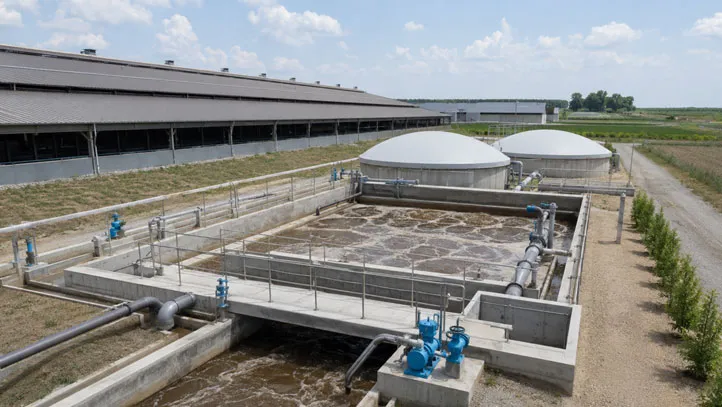
A wastewater storage tank is not selected by volume alone. The coating must tolerate the stored liquid and vapor space, while the shell, foundation, bolts, sealant, roof, nozzles and installation must resist structural and operating loads for the intended service life. For buyers comparing a glass-fused-to-steel tank with an epoxy-coated bolted tank, the correct question is not “Which coating is universally better?” but “Which complete tank system is better for this media, site, standard and maintenance plan?”
This guide is designed for owners, EPC contractors, consultants and procurement teams evaluating municipal water storage, industrial effluent, livestock wastewater, digestate, leachate, fire water or biogas infrastructure. It explains material behavior, coating quality, chemical compatibility, structural standards, joint sealing, foundation tolerances, quality inspection and lifecycle cost.
The choice is commercially important because tank failures are expensive to correct after installation. Buyers need more than a coating label: they need enough engineering information to define stored media, structural loads, standards, inspection methods and acceptance documents before sending an RFQ.
Yikang supplies both glass-fused-to-steel and epoxy-coated bolted tank systems. Offering both technologies allows the selection to begin with project duty rather than forcing every application into one coating category.
What Is a Glass-Fused-to-Steel Wastewater Storage Tank?
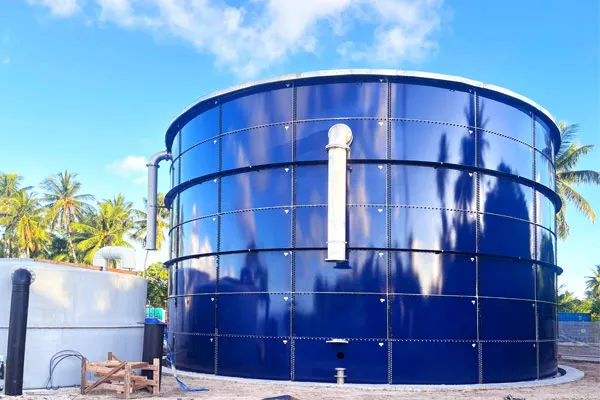
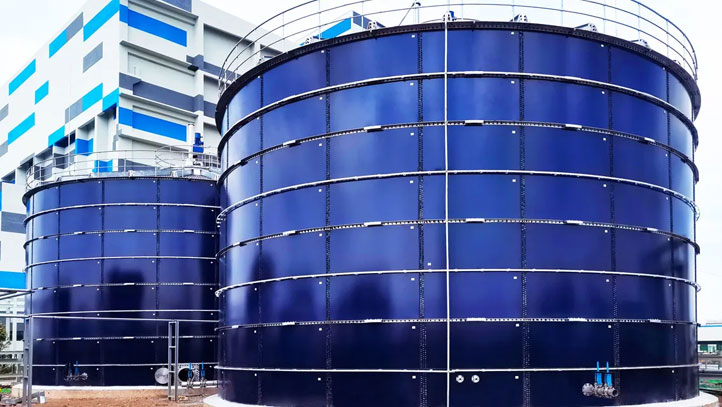
A glass-fused-to-steel tank is a bolted steel tank whose panels are coated with vitreous enamel that is fired at high temperature to create a hard glass-like layer bonded to the steel substrate.
The steel carries structural loads, while the fused glass surface provides a smooth, chemically resistant barrier. The panels are manufactured in controlled factory conditions, drilled, coated, fired, inspected and shipped to site for bolted assembly. Joints are sealed with a project-compatible sealant.
Yikang states that its glass-fused-to-steel panels are fired at approximately 820–930°C. Its published standard coating thickness is 250–450 micrometres, with two coats as standard and three coats available. The page lists a standard pH range of 3–11, a special grade range of 1–14, holiday-test voltage from 900 to 1500 V depending on application, and a company-stated service life of more than 30 years.
These values are useful for initial screening, but they are not a universal performance guarantee. The procurement specification should identify the exact panel grade, coating system, stored liquid, temperature, immersion condition, test method and acceptance criteria. The buyer should also verify whether the project is designed to ISO 28765, ANSI/AWWA D103 or another applicable standard.
As a glass fused to steel tank manufacturer, Yikang presents these tanks for municipal water, industrial wastewater, leachate, fire water, biogas and livestock-wastewater applications. Suitability still needs confirmation for the exact chemical and operating envelope.
What Is an Epoxy-Coated Wastewater Treatment Tank?
An epoxy-coated bolted steel tank uses factory-applied thermosetting epoxy on the liquid-contact surface and a suitable external coating system to protect modular steel panels in service.
Fusion-bonded epoxy powder is applied to prepared steel and cured to form a continuous polymeric barrier. Compared with vitreous enamel, epoxy is an organic coating and can offer toughness, flexibility and a wide range of formulation options. Performance depends strongly on surface preparation, cure, film thickness, edge coverage, handling and inspection.
Yikang’s published system uses fusion-bonded epoxy internally and polyester externally. The page lists minimum internal dry-film thicknesses of 200 micrometres for one grade and 300 micrometres for another. Published values include adhesion levels of at least 12 or 16 MPa depending on grade, salt-spray test options of 1000, 2000 or 4000 hours, a pH range of 3–13, impact resistance of at least 18 J and abrasion loss below 40 mg after 1000 cycles under the stated test.
Those figures should be tied to an exact grade and test report. Salt-spray hours, for example, are a comparative laboratory result; they do not directly equal years of immersion service. A buyer should ask how the coating system was qualified for the proposed liquid, temperature, cleaning practice and design life.
Yikang positions its wastewater treatment tank range for wastewater, conventional water and industrial liquid storage. Potable-water use, strong solvents, concentrated chemicals or elevated temperatures require explicit product certification and compatibility review.
Glass-Fused-to-Steel vs Epoxy Bolted Wastewater Storage Tanks
Glass-fused-to-steel uses an inorganic vitreous enamel barrier, while epoxy-coated steel uses a cured organic polymer barrier; each responds differently to impact, flexibility, chemicals, temperature and repair.
| Factor | Glass-fused-to-steel | Epoxy-coated steel |
|---|
| Coating family | Inorganic vitreous enamel fused to steel | Organic thermosetting polymer coating |
| Surface character | Hard, smooth, non-porous glass-like finish | Tough polymer film with grade-dependent flexibility |
| Factory process | Enamel application and high-temperature firing | Surface preparation, powder/liquid application and controlled cure |
| Impact behavior | Hard but localized chipping can occur under severe impact | Often more tolerant of deformation, but cutting or abrasion can expose steel |
| Repair | Localized site repair systems are possible but are not identical to factory fusion | Field repair with compatible epoxy can be more familiar, subject to preparation and cure |
| UV exposure | Enamel color and surface generally resist UV well | External polyester or other topcoat protects against weathering |
| Chemical resistance | Broad for many aqueous services; grade and pH/temperature matter | Formulation-specific; can perform well across many water/wastewater services |
| Thermal movement | Panel/enamel system engineered around steel and fused layer | Polymer flexibility and thermal limits depend on formulation and cure |
| Quality risks | Firing, edge coverage, impact damage, holidays and glass defects | Surface preparation, cure, pinholes, thin edges, contamination and handling damage |
| Selection logic | Often favored for long-life, hard, smooth environmental storage surfaces | Often favored where epoxy grade, cost, toughness or repairability fits the duty |
Neither column means “always better.” A high-quality epoxy tank can outperform a poorly specified enamel tank, and the reverse is also true. The correct comparison must hold structural design, steel quality, bolts, sealant, roof, nozzles, foundation, installation and inspection constant.
Which Tank Type Fits Water, Wastewater and Biogas Applications?
Application fit is determined by media chemistry, temperature, gas exposure, structural loads, hygiene requirements, inspection access and the owner’s maintenance strategy.
| Application | Key selection questions | Specification priority |
|---|
| Potable water | Are all wetted materials approved for drinking-water contact? Can the roof, vents and overflow prevent contamination? | NSF/ANSI/CAN 61 or locally required approval, hygienic detailing and documented sealant compatibility |
| Municipal wastewater | What are the normal and upset pH, sulfide, solids, cleaning chemicals and vapor-space conditions? | Coating compatibility, abrasion control, corrosion-resistant accessories and safe inspection access |
| Industrial wastewater | Which specific chemicals, concentrations and temperatures are present? Are solvents or salts involved? | Written media compatibility, coupon or reference evidence and clearly defined upset limits |
| Livestock wastewater and digestate | Will the tank store raw manure, equalized wastewater, sludge or digestate? Is mixing required? | Solids handling, mixer loads, nozzle reinforcement, gas and odor connections, cleanout design |
| Anaerobic digester | What internal pressure, vacuum, temperature, gas composition and mixing loads apply? | Gas-tight roof and joints, pressure/vacuum protection, vapor-space compatibility and integrated safety design |
| Fire-water reserve | Which fire code, seismic demand, usable volume and connection arrangement apply? | Structural standard, reliable outlet capacity, inspection and emergency availability |
The same shell diameter can represent very different engineering risk. A potable-water tank prioritizes hygienic materials and contamination control. A wastewater treatment tank may need resistance to sulfide, abrasion and cleaning chemicals. A digester must manage gas pressure, vacuum and corrosive condensate above the liquid. The coating decision must follow this complete duty description.
How Stored Media Change the Tank Selection
Stored-media compatibility depends on chemical composition, concentration, pH, temperature, solids, gases, cleaning agents and whether exposure is continuous, cyclic or intermittent.
Wastewater is not defined by pH alone. Chlorides, sulfides, ammonia, organic acids, solvents, oils, abrasives and biological deposits can change corrosion risk. A tank storing equalized municipal wastewater has a different duty from a digester, leachate tank, high-salinity industrial stream or chemical-cleaning vessel.
Ask the process designer for a media data sheet. It should include normal and upset pH, temperature, conductivity, chloride, sulfate, sulfide, ammonia, oil, solvents, suspended solids, gas composition and cleaning chemicals. Include vapor-space conditions because condensation and gas exposure above the liquid can differ from immersion below it.
For abrasive slurries, define particle hardness, concentration, velocity and mixing. A coating that is chemically resistant can still wear at inlet impingement zones or near mixers. Use diffusers, baffles, replaceable wear protection or nozzle design where required.
For biogas and digesters, define internal pressure and vacuum, gas composition, foam, scum, temperature, mixing loads and roof type. Hydrogen sulfide and condensate can create aggressive vapor-space conditions. The tank, roof, membrane, sealant and penetrations must be designed as one gas-tight system.
Using pH Range Correctly in a Bolted Tank Specification
A published pH range is a screening indicator, not a complete chemical-resistance guarantee.
Yikang publishes standard and special pH ranges for glass-fused-to-steel and a pH range for its epoxy system. These values do not eliminate the need to identify the actual chemical species. Two liquids at pH 4 can have very different corrosion behavior. Temperature can accelerate chemical attack, and concentrated exposure can differ from dilute wastewater.
Specify normal pH, credible upset pH, duration and frequency. If cleaning uses acid or alkali, provide concentration, temperature, contact time and rinse procedure. Ask the supplier for written compatibility confirmation for both liquid and vapor phases.
Do not assume a “special grade” is included in the standard quotation. The grade should appear in the bill of materials, coating certificate, inspection plan and panel marking. Where the medium is unusual, require coupon testing, immersion data or a documented reference application.
Structural Design Is More Than Tank Volume
Structural tank design converts storage volume and site loads into shell thickness, panel arrangement, bolts, stiffeners, roof, foundation and anchorage.
Provide working volume, freeboard, minimum and maximum level, diameter or footprint limits, operating temperature, liquid density and any internal pressure or vacuum. Sludge and brine can be denser than water. Settled solids can create local loads and affect cleaning.
Site data should include wind, seismic classification, snow, elevation, soil, groundwater, flood risk and corrosion environment. The foundation designer needs allowable bearing capacity, settlement criteria, anchor loads, ring-beam geometry, floor detail and construction tolerances.
ISO 28765:2022 covers the design and use of vitreous-enamel-coated bolted cylindrical steel tanks for water, municipal or industrial effluents and sludges within its stated scope. ANSI/AWWA D103 addresses factory-coated bolted carbon steel tanks for water storage. A project may also be governed by local building, seismic, fire, potable-water, environmental or pressure requirements.
The contract should identify the governing standard and edition, plus all deviations. “Designed according to international standards” is too vague for engineering review.
Roof, Floor, Nozzles and Accessories
Tank accessories determine process function, safety, maintainability and leak risk and must be designed with the shell.
Roof choices can include open top, fixed steel, aluminum dome, membrane gas holder or other systems. Define live loads, gas tightness, corrosion protection, access, vents, pressure/vacuum relief, odor connection and fall protection. A water-storage roof and a digester gas roof have different responsibilities.
The floor may be coated steel, concrete, membrane or another design. The shell-to-floor joint is critical. Detail water stops, sealant, grout, edge protection and leak detection. Foundation and tank suppliers must agree on tolerances before concrete is poured.
List every nozzle with size, elevation, orientation, load, flange standard and service. Include mixers, ladders, platforms, manways, level instruments, sample points, overflow, drains, recirculation, heating and cleaning. Nozzle loads from piping should not be transferred into the panel without review.
Dissimilar metals can create galvanic or contamination concerns. Define stainless-steel accessories, isolation, fasteners and submerged components. Potable-water tanks need sanitary vents, screened overflows, sealed hatches and materials suitable for drinking-water contact.
Bolts, Sealant and Joint Design
Bolted joints combine structural clamping and flexible sealing, making bolt specification, hole quality, sealant compatibility and installation control essential.
Specify bolt material, coating, strength class, head protection, washer arrangement and whether bolts are exposed to the stored medium. Edge and hole coating must be inspected because drilling or handling damage can expose steel.
Sealant must be compatible with the liquid, gas, temperature, cleaning chemicals and intended certification. Cure conditions and shelf life matter. A sealant suitable for potable water may need specific certification; a digester sealant must tolerate gas and movement.
Installation procedures should define surface cleaning, bead size, overlap, bolt sequence, tightening method and rework. Torque alone may not indicate clamping force if friction varies. Use the manufacturer’s validated method and record lot, weather and installer checks.
Joint leaks are often treated as an installation problem, but design tolerances, foundation settlement, panel damage and nozzle loads can also contribute. Acceptance should include visual inspection and a controlled hydrostatic or leak test appropriate to the service.
Coating Thickness, Adhesion and Cure
Coating quality is controlled by substrate preparation, application, thickness, bonding, cure or firing, edge coverage and freedom from discontinuities.
For glass-fused-to-steel, the supplier should document steel grade, enamel system, firing cycle, coating thickness, color, adhesion, visual defects and holiday inspection. Excessive or insufficient firing can affect the bond and surface. Edge and hole quality deserve special attention.
For epoxy, surface cleanliness and profile are fundamental. Contamination under a coating can cause blistering or disbondment. Cure should be verified according to the coating system. Dry-film thickness measurements need a calibrated instrument and a sampling plan that includes edges and difficult areas.
Published adhesion and abrasion values are useful only when the test method, sample preparation and acceptance are known. Request the relevant test report for the offered grade. Do not combine the best values from different grades into one specification.
Holiday Testing for Glass-Fused-to-Steel and Epoxy Tanks
Holiday testing uses electrical methods to detect pinholes, voids or discontinuities in a nonconductive coating over conductive steel.
The test voltage must match coating type, thickness, standard and manufacturer procedure. Too low a voltage may miss defects; too high a voltage can damage the coating or create misleading results. Wet-sponge and high-voltage methods serve different thicknesses and systems.
Yikang publishes 900–1500 V for its glass-fused-to-steel system depending on application. That range should be converted into a project inspection procedure identifying instrument, calibration, voltage, electrode, scanning speed, panel area, acceptance and repair.
AMPP SP0188 covers discontinuity testing of new protective coatings on conductive substrates. The procurement document should cite the applicable edition or the tank/coating manufacturer’s validated procedure. Testing every panel at the factory does not eliminate the need to inspect after shipping and installation because handling can create damage.
Potable Water, Wastewater and Certification Boundaries
Potable-water suitability requires material health-effects compliance and sanitary design in addition to structural and corrosion performance.
NSF/ANSI/CAN 61 establishes health-effects requirements for materials and components that contact drinking water. It does not by itself certify structural performance, taste, odor or microbial growth support. If potable use is required, ask for current third-party certification for the exact coating, sealant and product configuration.
Wastewater tanks may not require potable-water certification, but they still need material compatibility, environmental compliance and worker safety. Fire-water tanks may have fire-code, insurer and pump-system requirements. Process-water tanks may need product-purity controls.
Do not accept a general statement that the “factory is certified.” Certification should identify the manufacturer, product, standard, model or material, facility and validity. If certification is optional, include it explicitly in the quotation and documentation schedule.
Installation and Foundation Quality
Tank installation converts factory-made panels into a watertight structure, so site tolerances, handling, cleanliness and assembly records directly affect service life.
Before delivery, confirm access for containers, cranes, jacks and panel storage. Panels should be protected from impact, moisture traps and contamination. Inspect packaging on arrival and quarantine damaged panels for supplier review.
Survey the foundation for level, diameter, elevation, anchor positions and ring-beam tolerances. Record results before assembly. Do not force panels to fit an out-of-tolerance foundation because that can create joint stress and alignment problems.
Protect coated surfaces from tools, welding sparks and concrete contamination. Field cutting or drilling should follow an approved repair procedure. Keep sealant surfaces clean and dry within the allowable weather window. Record panel numbers, bolt and sealant lots, repair locations and inspection results.
Yikang is among the bolted tank manufacturers supplying modular systems, but modular does not mean installation is unskilled. The buyer should require trained supervision, method statements, hold points and a completion dossier.
Factory Acceptance and Site Acceptance
Factory and site acceptance verify that the tank components, coatings, accessories, documentation and completed installation meet the agreed specification.
| Stage | Typical verification |
|---|
| Design review | Volume, loads, standard, shell calculation, roof, nozzles, foundation reactions |
| Incoming steel | Grade, thickness, heat traceability and surface condition |
| Panel fabrication | Dimensions, holes, edges, flatness and identification |
| Coating | System/grade, thickness, firing or cure, appearance, adhesion and holidays |
| Hardware | Bolts, washers, sealant, accessories, certificates and shelf life |
| Packaging | Panel separation, edge protection, labels and shipping list |
| Foundation | Survey, anchors, ring beam, floor and tolerances |
| Erection | Panel sequence, joints, torque/control method, repairs and weather records |
| Completion | Dimensional survey, cleaning, leak/hydro test, roof and accessories |
| Dossier | Drawings, calculations, certificates, inspection records, manuals and warranty |
Hydrostatic testing should define fill rate, hold points, foundation observation, leak criteria, weather and disposal of test water. For potable service, cleaning and disinfection follow applicable requirements. For gas service, separate gas-tightness and safety testing may be required.
Maintenance and Inspection Over the Tank Lifecycle
Lifecycle inspection identifies coating damage, leaks, settlement, corrosion, sealant aging, accessory defects and sanitary risks before they become major failures.
Create an inspection schedule based on service and regulation. Routine external checks can review leaks, staining, bolt condition, settlement, roof drainage, vents, ladders and foundations. Internal inspection may require draining, cleaning, ventilation, gas testing and a confined-space program.
For finished-water storage, EPA notes risks from open hatches, damaged vent screens, animal contamination, sediment and biofilm. The specific inspection and cleaning interval should follow local rules, water-quality risk and asset condition.
Record every coating repair with location, preparation, product, batch, cure and test. Track settlement and shell alignment. Replace failed sealant or hardware using the manufacturer’s procedure. Do not cover corrosion or cracks without identifying the cause.
A company-stated 30-year service life for a GFS tank should be interpreted as a potential design/service expectation under appropriate conditions, not as permission to avoid maintenance. Media, installation, environment and inspection determine actual life.
Lifecycle Cost: Glass-Fused-to-Steel vs Epoxy-Coated Tanks
Lifecycle cost combines purchase, foundation, freight, erection, inspection, repair, downtime, cleaning, recoating and end-of-life consequences.
Initial panel price is only one component. Compare structural steel quantity, roof, foundation, accessories, installation labor, supervision, testing and schedule. A lighter quotation may exclude nozzles, internal piping, platforms, insulation or local design review.
GFS may provide a hard, durable, low-maintenance surface for many environmental applications. Localized impact damage can require specific repair. Epoxy may offer attractive cost and repair options, but performance depends on cure, film integrity and service compatibility. The actual difference is project-specific.
Downtime can dominate lifecycle cost when the tank supports a continuous wastewater or biogas process. Include spare storage, bypass prevention, cleaning access and repair time. For remote sites, spare parts and local installer capability matter.
Use net present cost over the owner’s evaluation period, with sensitivity for inspection frequency, repair, coating renewal, energy or heating accessories and expected expansion. Modular tanks can support future expansion only if foundation, hydraulics and site layout are planned for it.
How Yikang Approaches Bolted Wastewater Storage Tank Selection
A dual-technology supplier can compare enamel and epoxy systems against the same design basis instead of assuming one coating is correct for every project.
Yikang’s product structure includes a parent bolted-tank category plus dedicated glass-fused-to-steel and epoxy-coated steel tank pages. For buyers, the practical advantage is the ability to issue one media and site data sheet and request a written comparison of both alternatives.
The supplier response should identify the proposed coating grade, normal and upset compatibility limits, relevant standard, shell thickness, bolt and sealant system, roof and floor design, nozzle schedule, factory tests, site inspection and warranty exclusions. A proposal that only states “GFS” or “epoxy” is not detailed enough for technical evaluation.
Yikang publishes GFS applications including municipal potable water, industrial wastewater, leachate, fire-water reserve, biogas and livestock wastewater. Every application still requires project-specific confirmation. The published list establishes intended use; the final contract must establish the exact duty and acceptance criteria.
How to Choose Among Bolted Tank Manufacturers
The right bolted tank is the system that meets the stored medium, structural loads, standard, quality plan, installation conditions and lifecycle objectives with verifiable evidence.
Define service. State liquid, solids, gas, temperature, pH, chemistry, pressure/vacuum and cleaning.
Set structural criteria. Provide capacity, site loads, design code, density, roof and foundation inputs.
Screen coatings. Compare written compatibility, grade-specific data and relevant references.
Specify accessories. Complete the nozzle, roof, floor, mixer, access and instrumentation schedule.
Define QA. Identify coating tests, holiday procedure, sampling, documentation and witness points.
Control installation. Require foundation survey, trained supervision, panel traceability and repair records.
Plan acceptance. Include leak/hydro testing, gas testing where applicable, cleaning and dossier review.
Compare lifecycle cost. Hold scope and performance constant across proposals.
Use a deviation schedule. Every supplier should state where its design differs from the specification. This prevents a low price from winning by silently reducing coating grade, steel, accessories, testing or installation scope.
Frequently Asked Questions About Bolted Wastewater Storage Tanks
These questions address the most common buyer concerns about coating selection, standards, repair and service life.
Is glass-fused-to-steel always better than epoxy?
No. GFS offers a hard vitreous surface and broad environmental use, while a properly selected epoxy system can provide strong corrosion protection and practical repairability. The medium, temperature, impact risk, standard, QA and lifecycle cost determine the better option.
Can both tank types store drinking water?
Potentially, but potable use requires current certification for the exact coating, sealant and components, plus sanitary tank design. Do not infer potable suitability from a general wastewater application or factory certificate.
What does a holiday test find?
It detects electrical discontinuities such as pinholes or voids in a nonconductive coating over conductive steel. The method and voltage must match coating thickness, material and the applicable standard or validated procedure.
Can a damaged panel be repaired onsite?
Localized repair may be possible using an approved system. The repair must include surface preparation, compatible material, cure and inspection. Severe deformation, large coating loss or structural damage may require panel replacement.
How long does a bolted steel tank last?
Service life depends on coating, medium, temperature, structural design, installation, environment, inspection and maintenance. Supplier life claims should state assumptions and warranty terms; they are not universal guarantees.
What information should be sent for a tank quotation?
Provide capacity, dimensions, medium analysis, pH, temperature, density, solids, pressure/vacuum, site wind/seismic/snow, standard, roof, floor, nozzles, accessories, certification, installation scope and schedule.
Conclusion: Specify the Complete Tank, Not Only the Coating
A defensible tank decision compares glass-fused-to-steel and epoxy as parts of complete engineered systems with defined service, structure, quality and lifecycle obligations.
GFS and epoxy-coated bolted tanks can both provide effective modular storage. GFS uses a fired vitreous enamel layer; epoxy uses a cured polymer film. Their published pH, coating, adhesion, abrasion and test data are valuable screening tools, but they cannot replace media compatibility, structural calculations, design standards, foundation control, installation QA and inspection.
Yikang Ecological can review the storage duty and propose a grade and configuration. To receive a meaningful offer, buyers should share the liquid and gas analysis, operating envelope, site loads, applicable standard, complete accessory list, certification needs and project scope. The resulting proposal should identify the exact coating grade, tests, exclusions and acceptance documents so that price reflects a comparable technical solution.
External References
The following independent sources cover bolted enamel tank design, drinking-water material health effects and water-storage inspection.
 English